
How Gold Exploration Teaches Us to Discover Innovation Opportunities Early
Gold exploration is one of the best metaphors for spotting innovation opportunities before they become obvious. Bakroe explores prospecting strategies, geological thinking, risk management, and modern AI tools that help entrepreneurs find “gold” in emerging technologies, markets, and business models.

Table of Contents
- Introduction: The Gold Rush Mindset for Innovators
- Historical Lessons from Gold Rushes
- Geological Thinking: How to Read the Terrain of Innovation
- Prospecting Methods: From Pan to AI-Powered Exploration
- Risk Management: Why Most Prospectors Fail and How to Succeed
- Modern Tools: AI, Satellites, and Data in Gold & Innovation Exploration
- The Bakroe Prospecting Framework for Innovation Opportunities
- Real-World Case Studies: Applying Gold Exploration to Tech & Business
- Startup Opportunities: Building Picks & Shovels for the Innovation Rush
- Common Pitfalls and How to Avoid Them
- Practical Next Steps: Start Prospecting Today
- Conclusion: The Bakroe Spirit – Prospect Early, Persist Wisely
- Frequently Asked Questions
Introduction: The Gold Rush Mindset for Innovators
Gold exploration is not just about digging holes in the ground. It is a disciplined, scientific, and highly uncertain hunt for hidden value in vast, often hostile terrain. Only a tiny fraction of prospects ever become profitable mines — yet the rewards for those who succeed are enormous.
This exact pattern mirrors innovation and opportunity discovery in business and technology. Most new ideas fail. The terrain (market, technology, regulation) is complex and deceptive. Yet the entrepreneurs who develop the right “prospecting skills” consistently find high-potential opportunities long before they become obvious to everyone else.
In this comprehensive 3000-word guide, Bakroe draws direct parallels between gold exploration and innovation strategy. You will learn how to read weak signals, manage exploration risk, use modern tools (including AI), and build a repeatable framework for discovering innovation opportunities early — the true Bakroe Spirit.
Historical Lessons from Gold Rushes
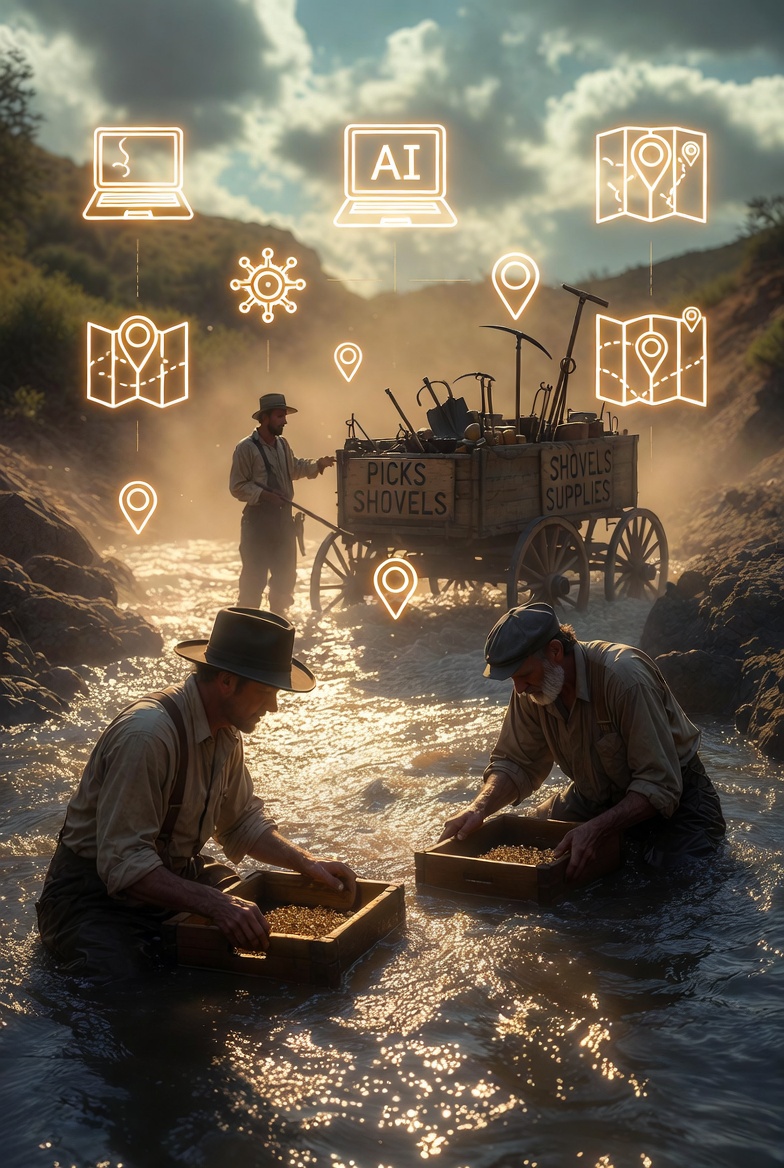
The California Gold Rush of 1848–1855 attracted hundreds of thousands of fortune seekers. Very few miners became rich from gold itself. The real winners were those who sold picks, shovels, denim jeans (Levi Strauss), coffee, banking services, and transportation.
Samuel Brannan famously bought every pickaxe and shovel in San Francisco, then shouted “Gold!” in the streets to spark the rush — profiting massively from equipment sales. This “picks and shovels” lesson remains powerful today: in any gold rush (technological or otherwise), the infrastructure providers often capture more reliable value than the direct prospectors.
Similar patterns appeared in the Klondike Gold Rush, the Australian Gold Rush, and the South African Witwatersrand discovery. Time and again, the people who made the most consistent fortunes were not the ones who struck the richest veins, but those who understood the ecosystem around the rush.
Geological Thinking: How to Read the Terrain of Innovation
Professional gold explorers do not dig randomly. They study geological maps, fault lines, alteration zones, and indicator minerals. They understand that gold often concentrates where different rock types meet or where ancient hydrothermal fluids flowed.
Innovation opportunity discovery works the same way. Successful founders develop “geological thinking” — the ability to read market signals, technological intersections, regulatory shifts, and customer pain points as “fault lines” where value concentrates.
Key geological principles applied to innovation include convergence zones (where AI meets healthcare or climate tech), alteration halos (early weak signals like rising search interest or pilot projects), and structural traps (regulatory changes or supply chain disruptions that create concentrated value).

Prospecting Methods: From Pan to AI-Powered Exploration
Traditional prospecting used pans, sluices, and visual inspection. Modern gold exploration employs geophysics, geochemistry, remote sensing, and drilling. In 2026, AI and satellite hyperspectral imaging dramatically increase success rates by analyzing vast datasets for subtle patterns humans might miss.
Entrepreneurs can adopt the same progression: stream sediment sampling (broad trend scanning), geophysical surveys (deep competitive analysis), and drilling (MVP testing in real market conditions). Today’s innovators have a massive advantage — AI tools that can process enormous amounts of data (patents, research papers, job postings, consumer sentiment) to highlight high-potential “deposits” faster than ever before.

Risk Management: Why Most Prospectors Fail and How to Succeed
Less than 0.1% of explored sites become producing mines. The same statistic roughly applies to startups. Professional explorers manage risk through portfolio approaches, staged investment, and rigorous validation at each step (anomaly detection → target ranking → drilling).
Innovation explorers should do the same: maintain a portfolio of ideas, kill weak ones early, and allocate more resources only after validation. The famous “three feet from gold” story reminds us that persistence without smart prospecting is futile — many failed miners stopped just short of rich seams because they lacked geological understanding.

Modern Tools: AI, Satellites, and Data in Gold & Innovation Exploration
In 2026, gold explorers use AI-driven predictive modeling, hyperspectral satellite imagery, drone geophysics, and real-time 3D subsurface imaging. These tools reduce exploration costs and risk while increasing discovery rates.
Innovation prospectors have parallel tools: AI-powered trend analysis, patent landscaping, consumer sentiment mining, and predictive analytics platforms. The best innovators combine human domain insight with these digital tools to see opportunities others miss.

The Bakroe Prospecting Framework for Innovation Opportunities
Bakroe’s practical 7-step framework draws directly from professional gold exploration:
- Terrain Analysis: Map the broad landscape (technologies, markets, regulations).
- Anomaly Detection: Identify weak signals and unusual patterns.
- Target Ranking: Prioritize based on size, accessibility, and defensibility.
- Ground Truthing: Validate with real customer interviews and small experiments.
- Resource Estimation: Assess potential value and required investment.
- Drilling / MVP Testing: Build and test in real conditions.
- Scale or Pivot: Decide whether to expand or move to the next prospect.
Real-World Case Studies: Applying Gold Exploration to Tech & Business
Early Airbnb founders “prospected” in the sharing economy when most people saw only spare rooms. Tesla bet on electric vehicles when batteries were expensive and charging infrastructure barely existed. Modern AI entrepreneurs focusing on vertical applications (like legal tech or healthcare diagnostics) identified rich “veins” before the broader market recognized their value. Each succeeded by reading subtle signals and persisting with disciplined exploration.
Startup Opportunities: Building Picks & Shovels for the Innovation Rush
In any innovation gold rush, the most consistent profits come from building the tools others need: AI-powered opportunity scanners, validation platforms, trend intelligence services, and vertical Micro SaaS that help companies prospect their own markets more effectively. These “picks and shovels” businesses often deliver more stable and scalable returns than chasing the next big idea directly.
Common Pitfalls and How to Avoid Them
Avoid “shiny object syndrome” (chasing every new trend), insufficient validation, and poor risk management. Successful prospectors stay disciplined, learn from dry holes quickly, and maintain a diversified portfolio of opportunities. The key is balancing optimism with rigorous evidence-based decision making.
Practical Next Steps: Start Prospecting Today
1. Choose one industry or technology domain you understand deeply.
2. Map the “geology” — key players, pain points, emerging signals.
3. Run a small prospecting exercise using the Bakroe framework.
4. Talk to 10 potential users or customers about their biggest frustrations.
5. Build one tiny experiment or landing page to test real demand.
Conclusion: The Bakroe Spirit – Prospect Early, Persist Wisely
Gold exploration teaches patience, scientific thinking, risk management, and the courage to explore where others see only barren rock. The same qualities separate entrepreneurs who discover innovation opportunities early from those who arrive too late to the gold rush.
Develop your prospecting skills. Read the terrain carefully. Validate rigorously. And remember — the real fortune often lies in the tools and services that help everyone else search more effectively.
Continue your journey with these Bakroe guides:
- AI Tools Every Entrepreneur Should Know
- Micro SaaS Ideas for 2026
- Agentic AI 2026
- Profitable AI Applications for Businesses
Frequently Asked Questions
How does gold exploration relate to innovation opportunity discovery?
Both involve searching vast uncertain terrain for hidden value using systematic methods, reading weak signals, managing high risk, and validating prospects before committing major resources.
What is the most important lesson from gold rushes for entrepreneurs?
The biggest winners often build the “picks and shovels” — the tools and infrastructure that support the rush — rather than chasing the gold itself.
How can modern AI tools help with innovation prospecting?
AI analyzes vast datasets (patents, research, market signals) to detect anomalies and rank opportunities faster and more accurately than traditional methods.
What is the Bakroe Prospecting Framework?
A 7-step process inspired by professional gold exploration: terrain analysis, anomaly detection, target ranking, ground truthing, resource estimation, MVP testing, and scale or pivot decisions.
Leave a Reply